How to Start a Blog as a Doctor
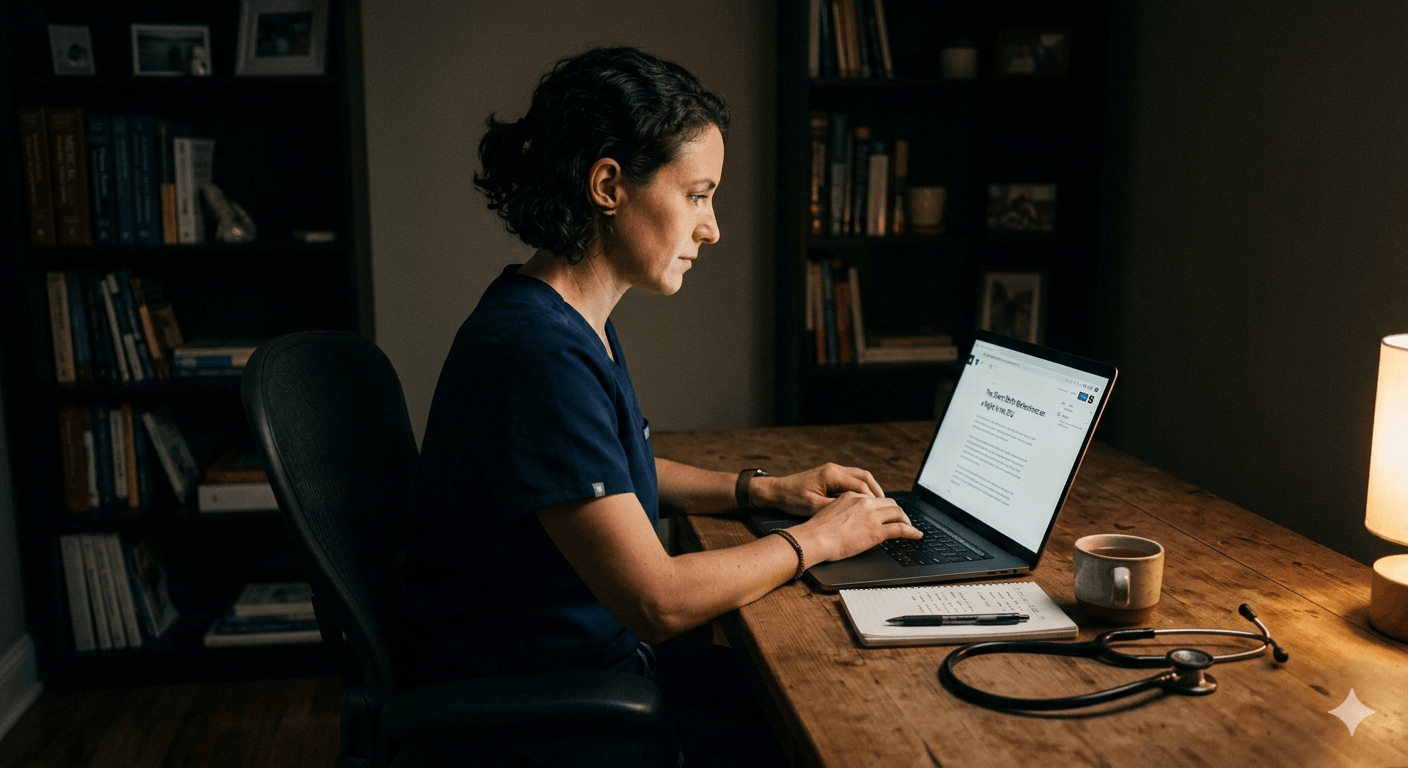
There is a quiet shift happening in medicine. Clinicians — doctors, nurses, pharmacists, physiotherapists — are building audiences online. They are writing articles, posting case breakdowns, and sharing hard-won clinical insight with the world. And they are doing it not because they are bored, but because they have figured something out that traditional medical training never taught them: your knowledge has value far beyond the ward.
This article is about how to start a blog as a clinician, why it matters more than ever in 2025, and what happens to your career when you do.
The Numbers Are Hard to Ignore
Medical misinformation is at an all-time high. 82% of adult social media users now report encountering false or misleading health information online, and 1 in 5 Americans turns to TikTok for health advice before speaking to a doctor. The demand for credible clinical voices on the internet has never been greater — and most of the search results people find are written by marketers, not clinicians.
At the same time, research on clinicians and online content creation reveals something striking: only about 1% of healthcare professionals who are online are actually producing original content — writing blogs, publishing articles, building forums. The other 99% are reading, scrolling, or occasionally commenting. That gap is not closing fast. Which means if you start a blog today, you are still entering a largely uncrowded space.
Meanwhile, the healthtech sector is pulling clinicians into new roles faster than most people realise. The global AI in healthcare market was valued at $21.66 billion in 2025 and is projected to reach $110.61 billion by 2030. These companies need clinicians — not just to advise on products, but to communicate them. They need people who understand medicine and can write, explain, and build trust with healthcare audiences. A blog is how you signal that you are one of those people.
And then there is burnout. 49% of physicians reported burnout in Medscape's 2024 survey — a number that has remained stubbornly above 45% for over a decade. Many are quietly looking for what comes next, or at least for something alongside clinical practice that doesn't drain them further. Writing, for a lot of clinicians who try it, turns out to be the opposite of draining.
What a Clinician Blog Actually Does For Your Career
Let's be specific, because "build your personal brand" is advice that sounds good and means nothing.
It creates a public record of your thinking. When a healthtech founder Googles your name before a call, or a journal editor looks you up before accepting your pitch, or a conference organiser tries to decide whether to invite you — what do they find? A blog gives them something real to read. It shows how you think, what you care about, and whether you can communicate.
It opens non-traditional clinical roles. Clinical writing, clinical advising, medical affairs, healthtech consulting, policy advocacy — all of these roles exist, and all of them are growing. Most of them go to clinicians who already have a public presence. A hiring manager at a digital health startup looking for a clinical lead is not posting on LinkedIn hoping an anonymous clinician applies. They are finding the people who are already talking about the problems they are trying to solve.
It builds a patient-facing reputation. If you run a practice or plan to, your blog is how patients decide whether to trust you before they ever book an appointment. 84% of patients now check online reviews and information before choosing a new provider — and 63% will choose one provider over another specifically because of a strong, informative online presence.
It compounds over time. A well-written article about a topic in your specialty can bring in readers for years. Unlike a tweet that disappears in 48 hours, a blog post is indexed by search engines and continues working for you long after you've moved on to writing the next one.
Physicians Who Did It — And What Happened Next
These are not hypothetical outcomes. They are documented stories of clinicians who started writing and watched their careers expand in ways clinical training never made possible.
Dr. Kevin Pho — KevinMD.com
In 2004, Dr. Kevin Pho, a primary care physician in New Hampshire, wrote a short post about a drug recall. A patient reached out to say the article had comforted them. That was the moment he realised clinicians could have a meaningful voice beyond the exam room. He kept writing. Twenty years later, KevinMD is one of the largest physician-written platforms in the world, receiving over 3 million monthly page views. What started as a blog became a speakers bureau, a coaching practice, a podcast, and a co-authored book on physician online reputation. None of that was planned. All of it followed from the decision to write consistently and in public.
Dr. Tammie Chang — Pediatric Oncologist and Community Builder
Dr. Tammie Chang is a practicing pediatric oncologist who used her online writing and platform to do something most clinicians consider impossible: build multiple careers simultaneously. Her work online helped her grow communities of over 125,000 verified physician members, author two bestselling books, and earn coverage in Forbes, CNN, and the Washington Post. She was named a LinkedIn Top Voice in Healthcare in 2020. She did not stop practising medicine. She expanded what medicine meant for her.
The pattern in both stories is the same. They started writing about what they already knew. They were consistent. They let the audience find them. And opportunities — speaking, publishing, advising, building — followed the visibility.
What to Write About
The best clinician blogs are not textbook summaries. They are a clinician's perspective on things people are actually searching for: how a diagnosis feels from the inside, what a test result means in plain language, why a treatment works the way it does, what you would tell a patient if you had more than 10 minutes.
You do not need to write about everything. The most powerful blogs are narrow and consistent. Pick a lane — your specialty, a patient population you care about, the intersection of medicine and technology — and write from inside it.
Some starting points that tend to work:
- "What I wish patients knew about [condition]"
- "What actually happens during [procedure]"
- "How I explain [diagnosis] to my patients"
- "Why I think AI will / won't change [area of medicine]"
- Case discussions (anonymised, with ethical principles applied)
- Reflections on clinical training, medical education, or the healthcare system
These are not just good for your readers. They are the exact topics people are searching for.
How to Set Up Your Clinician Blog
This is where most clinicians get stuck — not from lack of ideas, but from the wrong mental model. A clinician blog is not a technical project. It is a professional home. You want it to look credible, load quickly, and tell visitors exactly who you are and what you do.
Here is what you need:
1. A place to host your profile and writing. This is your home base. It should include your clinical background, your specialty, your credentials, and a way for people to contact or follow you. The simpler this is to set up, the sooner you will actually use it.
2. A domain that looks like you. yourname.com or yourname.bio — not a subdomain on a platform you don't control. When you write something good, you want people to remember where it lives.
3. A place to publish articles. This can be a blog section on your personal site, a Substack newsletter, or both. What matters is that it is yours, that it is easy to update, and that it does not require you to learn to code.
4. A consistent publishing rhythm. One article a month is enough to start. Two is better. The goal is consistency over volume — a blog with 12 well-written articles is more useful than one with 3 brilliant ones and a year of silence.
Where Ulna Fits In
Ulna (ulna.bio) was built specifically for clinicians who want a professional online presence without the friction of building a website from scratch.
You get a personal portfolio page with your credentials, specialty, work history, and links — all in a format designed for healthcare professionals. You can add your publications, your research, your speaking engagements, your blog. You can claim a clean personal URL. And you can set it up in under 30 minutes, without touching code.
Think of it as the clinical equivalent of a developer's GitHub profile — a place that shows what you know, what you've done, and what you're building. When you start a blog, Ulna is where that blog lives alongside everything else that makes you credible.
If you want to see what it looks like, head to Ulna and set up your profile. It's free to get started, and the first thing it will show you is how complete your professional presence actually is — which, for most clinicians, turns out to be more incomplete than they expected.
The Cost of Waiting
Here is the thing about clinician visibility: the window does not stay open forever.
Every specialty has a small number of clinicians who have already built a public presence. They are the ones who get invited to advisory boards, quoted in healthtech press releases, and approached for clinical writing contracts. They are not necessarily smarter or more experienced than their peers. They are just visible.
The gap between "clinician with a blog" and "clinician without one" is not a gap in knowledge. It is a gap in who gets found.
You have spent years building clinical expertise that most people in the world will never have. A blog is how you let that expertise travel further than the rooms you work in.
Start small. Write what you know. Build the thing.
Ulna is a portfolio and profile builder for clinicians. If you're ready to build your professional online presence, get started at ulna.bio.