AI for Doctors
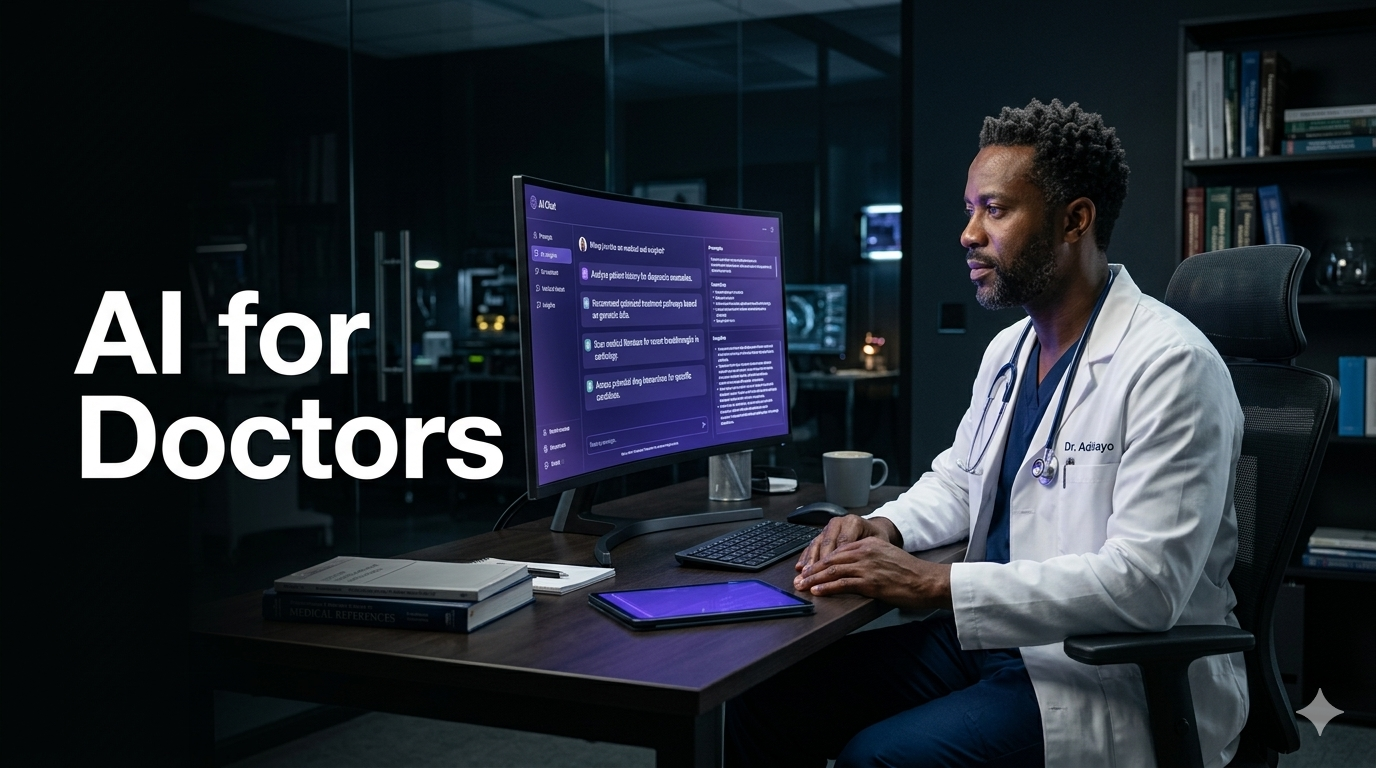
AI will not replace doctors. But doctors who use AI will have an advantage over those who don't — in speed, in learning, and in career options. This guide gives you everything you need to get started.
1. The Most Important Skill: Prompt Engineering
Prompt engineering is just knowing how to talk to AI well. The better your question, the better the answer.
The formula: Role + Context + Format
Bad prompt: "What's the treatment for malaria?"
Good prompt: "You are an infectious disease specialist. My patient is a 28-year-old pregnant woman in her second trimester with uncomplicated falciparum malaria in a chloroquine-resistant region. What is the safest first-line treatment and why? Give your answer in bullet points."
Same question. Completely different output. The second one is actually useful at the bedside.
Tips:
- Always give the AI a role ("You are a cardiologist...")
- Add patient context (age, comorbidities, relevant history)
- Tell it the format you want (bullet points, table, plain paragraph)
- If the answer isn't good enough, say "be more specific" or "simplify this for a patient"
Read more: Prompt Engineering for Clinicians
2. Tools Worth Knowing
General AI Assistants
Use these for drafting letters, summarising papers, explaining diagnoses to patients, studying, and clinical reasoning.
For clinical-specific questions with referenced literature, use:
OpenEvidence answers medical questions using real published studies. More reliable than general LLMs for bedside decisions.
AI Medical Scribes
These tools listen to your consultation and generate a structured clinical note automatically.
You stop typing mid-consultation. You look at your patient. The note writes itself.
Vibe Coding Tools (Build Without Coding)
These let you describe what you want in plain English and the AI builds it for you. No coding knowledge required.
What you can actually build as a doctor:
- A patient follow-up tracker for your ward
- A triage checklist app
- A referral letter template generator
- A personalised study quiz based on your weak areas
- A simple tool to explain diagnoses to patients at different literacy levels
You describe it. The AI builds it.
Medical Literature & Research
Use these to search research questions and get evidence-backed summaries faster than PubMed.
3. Courses to Take
AI 101: A Practical Guide for Clinicians
Free. Self-paced. Built specifically for clinicians and medical learners getting started with AI. https://dochobbs.github.io/ai101/index.html
Start here if you want zero fluff and immediate practical value.
Google's Introduction to Generative AI
Free. 45 minutes. Gives you a solid conceptual foundation. https://www.cloudskillsboost.google/courses/536
Good for understanding what AI actually is before you start using it.
AI in Healthcare Specialization — Stanford on Coursera
Paid (Coursera subscription). Structured and clinical. Built by Stanford faculty. https://www.coursera.org/specializations/ai-healthcare
The most rigorous option on this list. Worth it if you want to go deep.
4. Where to Stay Updated
- BMJ Digital Health
- JAMA Network (search "artificial intelligence")
- LinkedIn — follow clinicians and researchers working at the medicine-tech intersection
The conversation is happening in public. You just have to show up to it.
5. One Rule to Never Break
AI hallucinates. It can sound confident and be completely wrong. Never paste AI output directly into a patient's chart without reading and verifying it. Treat AI like a smart but occasionally unreliable colleague — useful, but not unsupervised.
Build Your Presence as a Clinician Who Gets This
If you want to start showing up online as a doctor who understands where medicine is going, build a portfolio.
Ulna — Free clinician portfolio tool with personal domains and prebuilt templates. Built for doctors.